Νέα της βιομηχανίας


Milky White PE (Coating): A Comprehensive Technical Overview
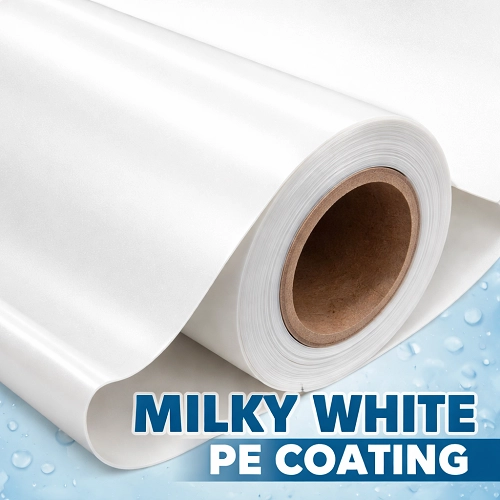
Milky White PE (Coating) refers to a polyethylene-based coating system characterized by an opaque, creamy white appearance and a suite of functional properties that make it valuable in numerous industrial, packaging, adhesive, and protective applications. At its core, this coating is built on polyethylene (PE) — one of the most widely used thermoplastic polymers globally — which when applied as a coating provides a robust balance of flexibility, moisture resistance, chemical protection, and aesthetic qualities.
1. What Is Milky White PE Coating?
Milky White PE (Coating) is essentially polyethylene applied as a surface layer on substrates such as paper, film, board, metal, or fabric. The polymer is processed in such a way that the finished coating displays a “milky” or creamy white look — not transparent like clear PE but opaque, offering both functional surface enhancement and visual uniformity.
Polyethylene Coating (PE) itself is valued for its:
- High moisture barrier properties
- Flexibility and toughness across temperatures
- Chemical resistance
- Electrical insulation characteristics
- Ease of processing (extrusion, lamination, etc.)
These inherent PE traits transfer into the milky white coating form, but with additional performance and aesthetic enhancements.
2. Material and Structural Characteristics
2.1 Core Polymer Matrix
PE coatings are typically derived from low-density (LDPE) or high-density polyethylene (HDPE) or blends of both, depending on the desired mechanical properties. LDPE contributes elasticity and toughness, while HDPE provides strength and structural integrity. In multi-layer film structures (e.g., for labels), layered compositions may be engineered with precise L/HDPE ratios to tailor stiffness, printability, and surface behavior.
2.2 Milky Appearance and Pigmentation
The milky opacity usually comes from controlled addition of pigments or masterbatch dispersions (e.g., titanium-based white pigments) that scatter light. This milky white shade enhances visual appeal, conceals underlying substrates, and can contribute to functional performance like light reflection.
2.3 Coating Uniformity & Surface Quality
PE coatings are engineered to produce a smooth, flat surface that enables reliable adhesion to adhesives or inks, critical in labeling and printing sectors. Surface consistency also improves laminating and die-cutting operations, with reduced edge curl and distortion.
3. Functional and Technical Properties
3.1 Moisture & Chemical Resistance
PE is inherently hydrophobic, forming an effective moisture barrier. In milky white coated forms, this results in:
- Low water vapor transmission
- Protection of substrates like paperboard in humid environments
- Resistance to a range of chemicals, acids, alkalis, and salts
These traits are crucial in packaging and industrial protection applications.
3.2 Durability & Flexibility
The coatings maintain flexibility even at lower temperatures, reducing cracking under mechanical stress — an advantage in dynamic applications like protective films or flexible packaging. PE’s mechanical resilience also enhances impact resistance in handling or transport.
3.3 Dimensional Stability
Milky white PE coatings improve dimensional stability of the coated substrate – especially in paper and film products – helping to maintain flatness and reduce deformation during processing (e.g., printing and converting).
3.4 Release Performance
When used over liner or label surfaces, PE coatings can be tailored to offer reliable and consistent release performance in laminate and adhesive assemblies — a key trait in label stock and specialty adhesive products.
4. Processing & Manufacturing Techniques
4.1 Extrusion Coating
One common method to apply PE coatings is extrusion coating, where molten PE is extruded through a die and cast onto a substrate. Key parameters include melt temperature, line speed, die gap width, and substrate prep (e.g., corona treatment) to ensure adhesion and uniformity.
4.2 Lamination & Heat Sealing
PE coatings can be laminated to other layers using heat and pressure, forming composite structures. Heat-sealability is tuned based on the PE grade and thickness to suit packaging needs.
4.3 Film Production Variants
In multi-layer film products — common for labels or protective films — specific layer compositions are engineered to balance stiffness, opacity, adhesion, and printability. Advanced film extrusion techniques control layer thickness and performance characteristics.
5. Applications Across Industries
Milky White PE coatings are extremely versatile — used where functional protection, surface quality, and aesthetic presentation are required:
5.1 Packaging
- Food packaging: liquid protective barriers in cartons and coated films
- Industrial packaging: enhanced moisture protection for goods in transit
PE coatings support packaging integrity and hygiene.
5.2 Labels & Printing
Opaque white surfaces provide a high-contrast background for printed matter, improving readability and print quality for product labels and tag stock.
5.3 Protective Films
Milky white PE films act as temporary protective layers on metal panels, glass, and other finished surfaces during transport and installation, shielding against scratches, dirt, and handling damage. Adhesive variants ensure residue-free removal.
5.4 Industrial & Construction Uses
In building materials and insulation films, PE coatings serve as vapor and moisture barriers, contributing to energy efficiency and substrate protection during construction workflows.
5.5 Specialty & Consumer Products
Beyond industrial uses, milky white PE finds niche roles in nonwoven textiles for hygiene products, medical protective clothing, and other consumer goods where barrier properties and aesthetic qualities are important.
6. Performance Enhancements & Future Trends
Manufacturers are continuously improving PE coating performance through:
- UV stabilization for outdoor durability
- Additives such as anti-block, anti-static, and slip agents for enhanced handling
- Sustainable formulations, including recycled content and bio-based PEG blends
These enhancements broaden the applicability of milky white PE coatings in emerging markets, from eco-centric packaging to advanced protective films.
Milky White PE (Coating) represents a technically rich and versatile polyethylene coating solution. Its hallmark combination of moisture resistance, mechanical resilience, chemical robustness, aesthetic uniformity, and adaptable processability makes it indispensable across a wide range of industrial and consumer applications. Whether in packaging, labeling, protective films, or specialty coatings, Milky White PE coatings continue to evolve — balancing performance, cost-efficiency, and environmental considerations in 21st-century materials engineering.